Day 027 · Morning
Morning Update: Wrapping PrintFetti, Building a Visual Brand & Starting the Next Redesign
This morning started a little earlier than usual.
Company is coming over for a lunch cookout later today, which means productivity will probably drop off once everyone arrives. Until then, the plan is to fit as much design and development work into the morning as possible.
Several projects are moving at the same time right now, but they all seem to connect around the same idea: building complete digital brands instead of simply building websites.
PrintFetti Is Ready for the Final Round
One of the bigger updates is that the PrintFetti website is pretty much wrapped up.
The main development work is finished. Now the site is waiting for the owner's final round of revisions, feedback, and visual approval.
Once those last changes are handled, the project can officially be called complete and added to the Life of AI portfolio as one of the newer examples of my development work.
That has become more of a focus lately. It is easy to jump straight into the next project, especially when working independently and experimenting with AI, design, development, and marketing at the same time.
But finishing the project is only part of the job.
Another habit I want to build is documenting the decisions behind each project, showing which problems were solved, explaining the technology and design process, and turning completed work into proper case studies.
PrintFetti should be one of the next projects to go through that process.
From Modeling Photos to a Full Visual Identity
Over the weekend, work also started on merchandise and visual concepts for my girlfriend's modeling brand.
Her actual website already has a repository, so what began as merch experimentation is turning into a larger branding project.
Instead of treating the website, photography, merchandise, and social media as completely separate pieces, the aim is to make them feel like parts of the same visual world.
One of my favorite concepts from the design process so far is a futuristic chrome interpretation of her as her own robotic character.
The idea takes elements that are already recognizable in her image—especially the pink hair and fashion aesthetic—and exaggerates them into something much more distinctive.
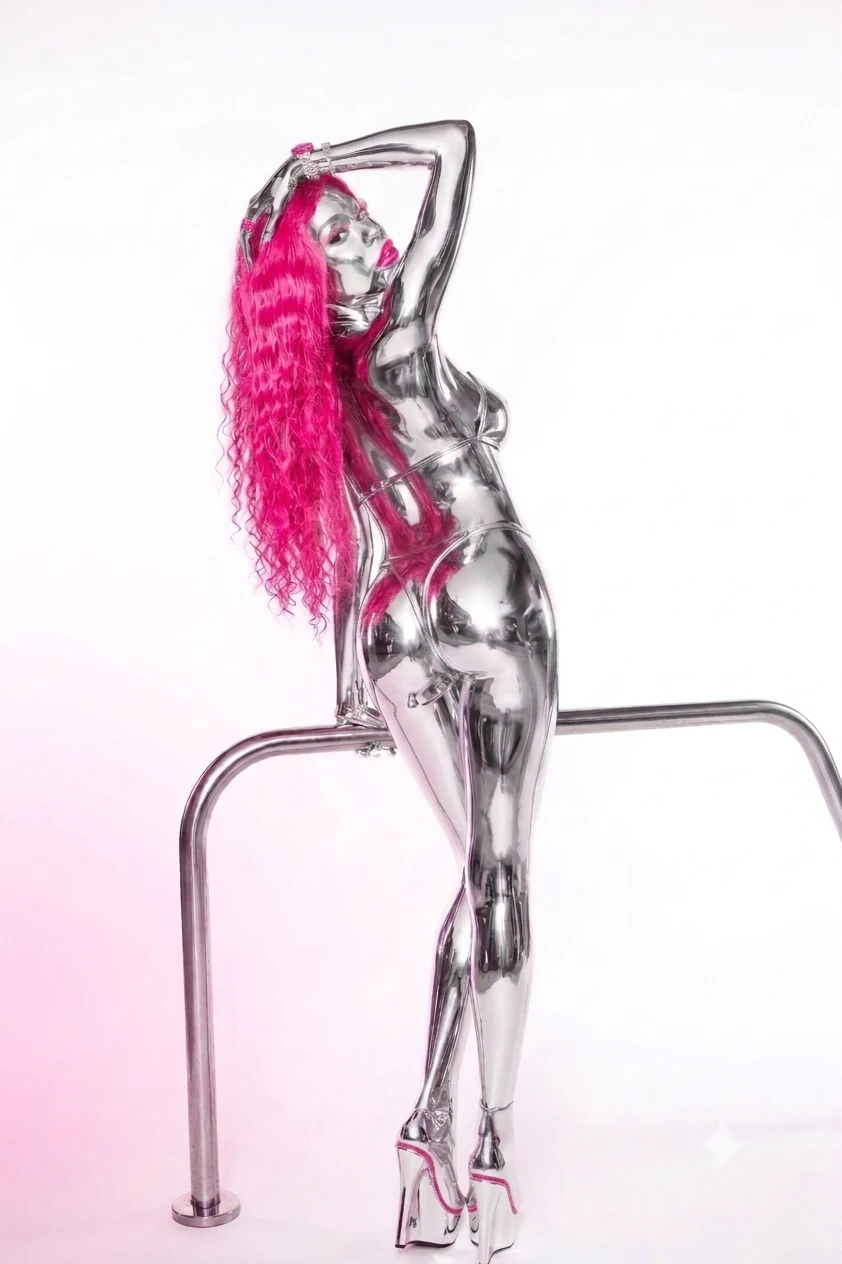
What excites me about this direction is that it moves beyond a traditional modeling website.
Most modeling portfolios naturally center on photography, and that will still be an important part of the site. A recognizable character, though, gives us another layer to work with.
That character can appear on shirts, posters, stickers, social graphics, promotional materials, website transitions, animations, and eventually even video content.
It starts becoming intellectual property and brand language rather than simply another photograph.
Taking the Character Concept Further
Another favorite concept pushed the chrome character into a Statue of Liberty-inspired interpretation.
Instead of simply copying the statue, the goal was to take recognizable elements—the crown, torch, draped clothing, and oxidized metal textures—and reinterpret them through the same futuristic visual language.
The result feels like a combination of fashion editorial, pop culture, futuristic design, and Americana.
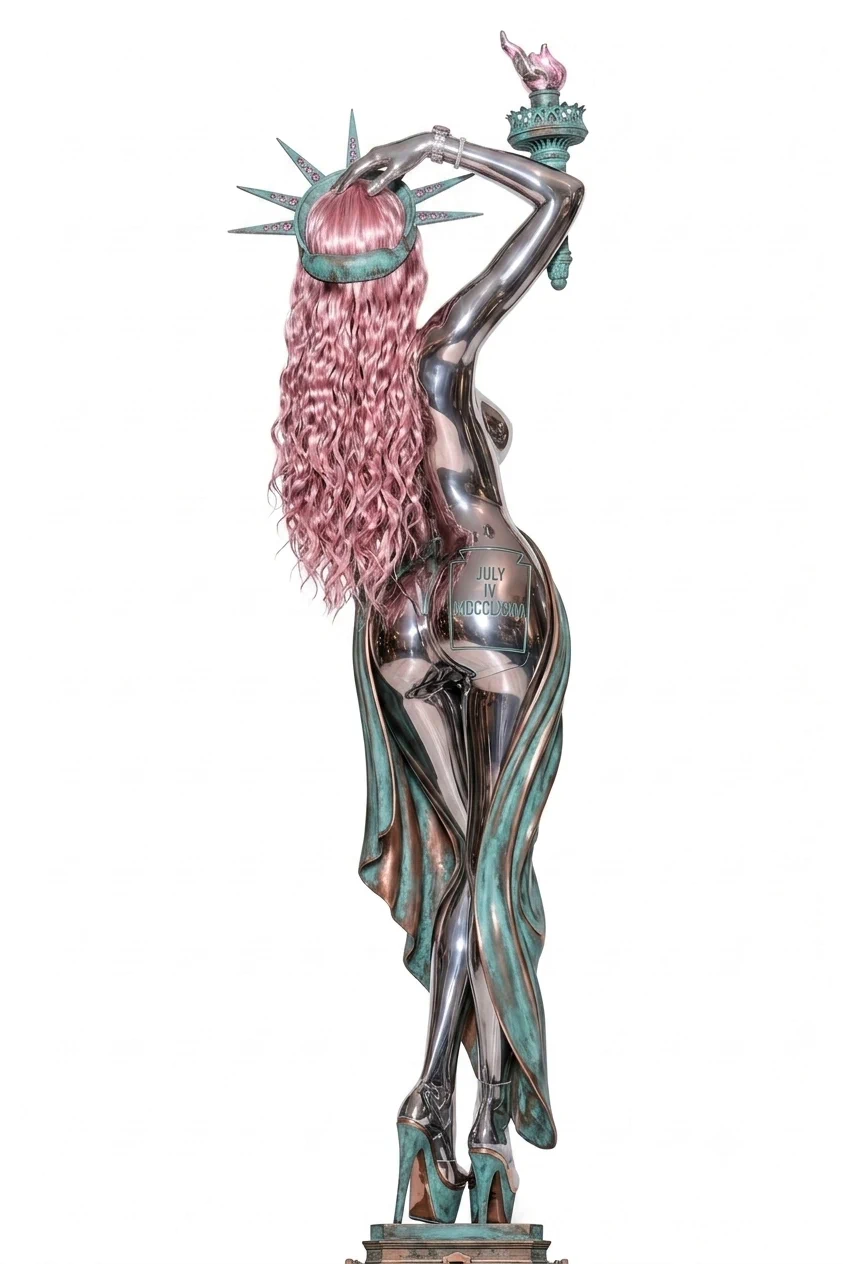
This is probably one of my favorite parts of the creative process.
It can begin with a person, a few photographs, colors, personality traits, and references. Then the questions get bigger:
- What would this look like if it were a complete world?
- What does the character look like?
- Which colors belong to the brand?
- What does the typography look like?
- What does the merchandise look like?
- What would a poster look like?
- What happens when somebody lands on the website?
- What should someone immediately recognize in a social post without even reading the username?
Those questions interest me much more than simply deciding where to put a navigation bar.
The Website Comes After the Identity
The repository for her site is already set up, but developing some of these visual ideas before getting too far into the interface feels like the right order.
Once there is a strong identity, website decisions become much easier.
The chrome, silver, pink, futuristic aesthetic can inform the typography, animations, buttons, backgrounds, photography treatment, transitions, and even the way individual projects are presented.
Rather than designing individual pages and trying to make them match afterward, the goal is to create a small design system around the personality of the brand.
That should also make it easier to reuse the same ideas across merchandise and social media.
Thinking About Social Media Account Management
Another subject on my mind lately is the operational side of managing multiple social media accounts.
The current plan is to pick up a few inexpensive Android phones so different projects and accounts can be separated more cleanly.
There are plenty of claims online about exactly how many accounts can safely exist on one device, but there does not appear to be a universal public rule where one specific number automatically results in a shadow ban.
Platforms look at much broader behavioral patterns.
If several accounts on the same device are constantly logging in and out, posting rapidly, performing repetitive actions, or heavily interacting with one another, those behaviors can potentially start to resemble spam or coordinated activity.
The useful approach, then, is not to reduce the question to a rule like:
Five accounts are safe and six accounts are not.
It is better to understand the broader signals platforms are trying to detect.
The goal is not to trick an algorithm. It is to structure account management in a way that makes operational sense while allowing every account to develop its own audience, content, purpose, and genuine engagement patterns.
That is something I want to keep researching and documenting through Life of AI, because social media infrastructure is becoming almost as important as the websites themselves.
Today's Next Project: Turning a Complicated Website Into a Brand
Until everyone arrives for the cookout, most of today's remaining work is going toward another design project.
This one brings together several areas that would not immediately sound like one brand:
- Weddings
- Motivational and public speaking
- Relationships
- Spirituality
- Personal philosophy and thought
The challenge is not that any of those subjects are bad. There is actually a lot of good existing content.
The problem is figuring out how everything fits beneath a clear identity.
That means the first step is not immediately redesigning pages. The existing material needs to be examined through two different questions:
- What is currently making the website difficult to brand?
- What is already working and needs to be preserved?
Those are two very different questions.
Redesigning Without Throwing Everything Away
One mistake that happens during redesigns is assuming that an ineffective presentation means everything underneath it needs to disappear.
Sometimes years of useful content are already sitting inside an unclear structure.
The real job is separating the content problem from the presentation problem.
The current audit is looking for:
- Inconsistent messaging
- Competing calls to action
- Too many subjects competing for attention
- Typography that does not establish hierarchy
- Colors that do not reinforce a recognizable identity
- Navigation that does not clearly explain the different parts of the brand
- Strong content buried inside weaker presentation
At the same time, the stories, ideas, videos, services, and written content that already have value need to be identified and preserved.
Then the redesign becomes less about replacing everything and more about organizing what already exists around a stronger identity.
Creating a Branding Identity Kit Before the Redesign
Before going too far into rebuilding the website, the next step is to put together a small branding and identity kit.
Nothing unnecessarily complicated—just enough to establish the rules.
That will likely include:
- Primary and secondary typography
- Color palette
- Photography direction
- Visual references
- Logo and wordmark direction
- Content pillars
- Voice and messaging
- Page hierarchy
- Service positioning
- Examples of potential layouts
- Examples of what currently is not working and why
Having that document gives the redesign a foundation.
Instead of saying, “I like this layout,” we can explain why that layout fits the brand.
And instead of endlessly changing colors, fonts, and styles page by page, there is a system that everything can reference.
The Bigger Pattern I'm Starting to Notice
A lot of my recent projects start in one place and eventually become something much larger:
- A client asks for a website.
- The website needs better branding.
- The branding needs content.
- The content needs social distribution.
- The social accounts need systems.
- The systems need automation.
- The automation needs data and oversight.
Eventually, it becomes clear that this is no longer just website design. It is the design of a digital ecosystem around a person or business.
That seems to be where a lot of my Life of AI work is naturally heading: the intersection of development, design, branding, AI, content, marketing, and automation.
That intersection is going to become a much bigger part of what gets documented here.
For now, a few hours remain before the grill gets fired up.
Back to designing.